
AcademicLabs Report on European Biotech Startups in Protein Degraders
Business Development-Weighted Landscape Assessment & Comparative Analysis
1. Introduction and Background
Targeted protein degradation, or TPD, has evolved from a niche chemical biology concept into a broad therapeutic strategy for eliminating disease-driving proteins rather than only inhibiting them. In the supplied company set, that evolution is visible in three distinct waves of innovation.
First, there is continued progress in more classical intracellular degrader approaches, including molecular glues and bifunctional degraders, but increasingly with efforts to move beyond the crowded CRBN and VHL landscape. Amphista is a strong example, positioning around non-CRBN/VHL Targeted Glue degraders and novel E3 ligases such as DCAF16 and FBXO22, with mechanistic support around DCAF16-mediated BRD9 degradation and near-clinical momentum for AMX-883 in AML (Amphista evidence, mechanistic publication, IND preparation). PhoreMost similarly represents the push toward more systematic molecular glue discovery and alternative E3 biology through GlueSEEKER and related platform outputs (PhoreMost evidence, platform abstract).
Second, the landscape is broadening beyond intracellular targets. Several profiles are compelling precisely because they extend degradation biology to extracellular, membrane-bound, or secreted targets. Laigo is advancing SureTAC bispecific antibodies for membrane-protein degradation (Laigo evidence); Draupnir is pursuing extracellular lysosomal routing using oral small molecules and sortilin-linked bifunctionals (Draupnir evidence, patent); GlycoEra is building bifunctional biologics for extracellular degradation in autoimmune disease (GlycoEra evidence).
Third, a subset of companies is testing non-canonical degradation architectures that may matter strategically if they prove translatable. Examples include Enodia with Sec61 or translocon-directed degradation at the point of synthesis (Enodia evidence); Booster with proteasome-stimulating Targeted Boosting Degraders, or Tarbods (Booster evidence); and Sibylla with folding-interference degraders via PPI-FIT (Sibylla evidence).
Business Development Framework: The objective of this report is not to identify the most academically interesting TPD startups in the abstract. It is to identify the companies most relevant for licensing, partnering, or acquisition by a pharma external innovation team. That requires balancing scientific novelty with practical actionability.
Accordingly, this report applies an evidence-based and conservative lens. Scores and tiers reflect only the supplied materials. Where mechanistic publications, patents, translational datasets, regulatory interactions, funding syndicates, or partnership signals are visible, confidence increases. Where evidence is thin, abstract-level, or web-page-only, confidence is reduced explicitly. This distinction matters across the current set: a handful of companies now merit active business development outreach, a broader watchlist merits selective diligence, and a long tail should be deprioritized for this specific mandate despite occasional scientific interest.
The central conclusion from the portfolio is that the opportunity set is real but uneven. The most attractive near-term targets combine direct TPD relevance, differentiated modality positioning, credible validation, and visible execution momentum. The rest divide between promising but under-validated next-wave platforms and profiles that are adjacent, enabling, acquired, or insufficiently evidenced for present action.
2. Evaluation Framework and Scoring Legend
This report uses five key criteria applied through a BD-weighted lens aligned to licensing, partnering, and acquisition objectives.
2.1 Core Criteria
2.2 Scoring Legend
All criteria are evaluated on a 1 to 10 scale:
2.3 Contextual Breakdown of Scores
2.4 Tiering Rules
2.5 Strategic & Interpretation Notes
The comparative ranking incorporates a commercial transaction overlay. Highly novel science can be outranked by execution maturity or commercial independence. For example, Dark Blue is scientifically elite but deprioritized due to its acquisition by Amgen. Conversely, entities like Selvita and Ubiquigent are valuable technical enablers but function better as specialized CRO/service counterparties than independent therapeutic pipeline investments.
3. Comparative Ranking of the 33 Targeted Protein Degrader Companies
Ranking reflects BD-weighted attractiveness for licensing, partnering, or M&A in TPD, not raw science alone. Scale 1–10. (P/F = Partnerships / Funding; Avg = Simple Arithmetic Mean).
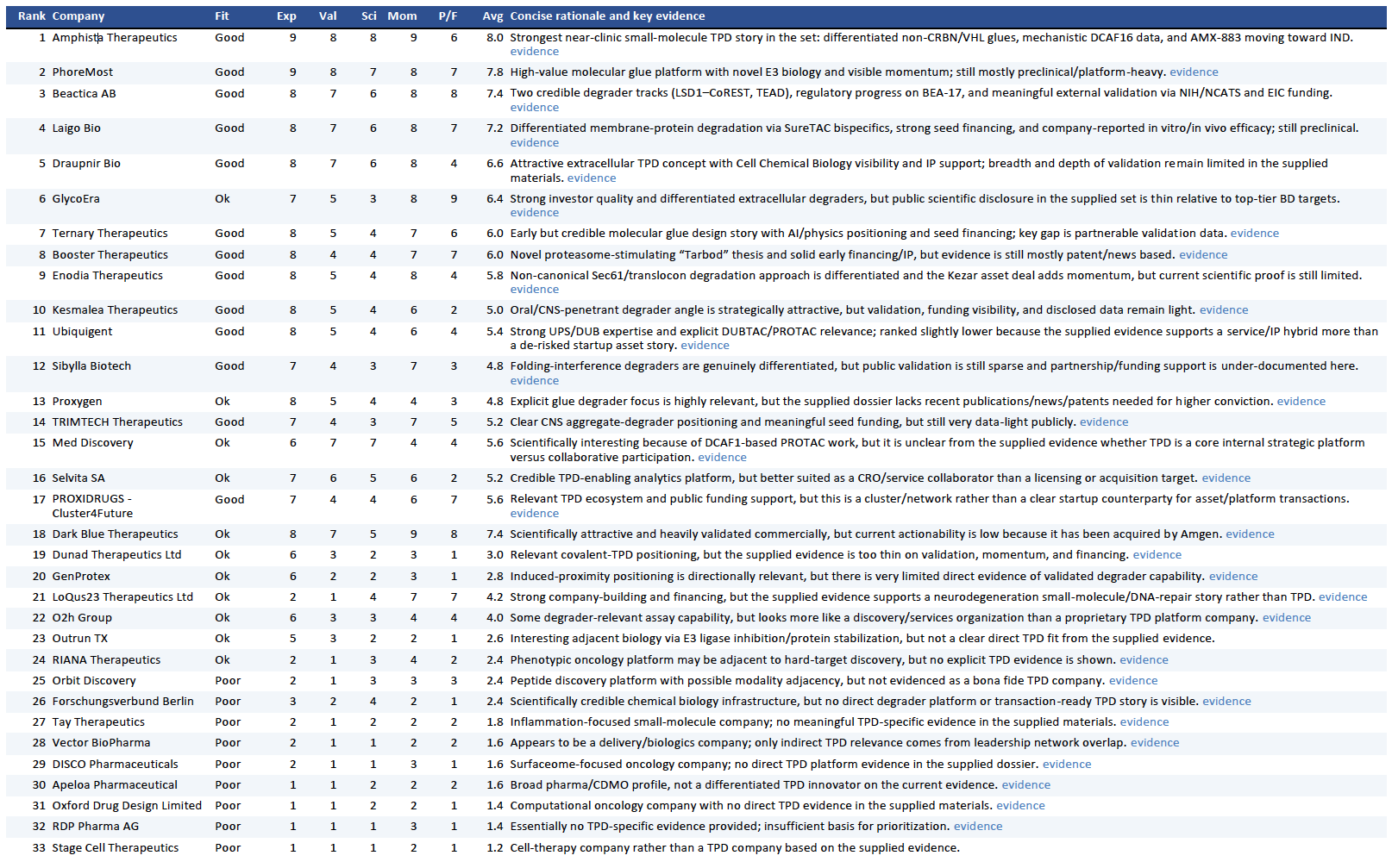
Top-Tier Rationale Summary
• Amphista Therapeutics (Rank 1, Avg 8.0): Strongest near-clinic small-molecule TPD story in the set: differentiated non-CRBN/VHL glues, mechanistic DCAF16 data, and AMX-883 moving toward IND.
• PhoreMost (Rank 2, Avg 7.8): High-value molecular glue platform with novel E3 biology and visible momentum; still mostly preclinical/platform-heavy.
• Beactica AB (Rank 3, Avg 7.4): Two credible degrader tracks (LSD1–CoREST, TEAD), regulatory progress on BEA-17, and meaningful external validation via NIH/NCATS and EIC funding.
• Laigo Bio (Rank 4, Avg 7.2): Differentiated membrane-protein degradation via SureTAC bispecifics, strong seed financing, and company-reported in vitro/in vivo efficacy; still preclinical.
• Draupnir Bio (Rank 5, Avg 6.6): Attractive extracellular TPD concept with Cell Chemical Biology visibility and IP support; breadth and depth of validation remain limited in the supplied materials.
• GlycoEra (Rank 6, Avg 6.4): Strong investor quality and differentiated extracellular degraders, but public scientific disclosure in the supplied set is thin relative to top-tier BD targets.
• Ternary Therapeutics (Rank 7, Avg 6.0): Early but credible molecular glue design story with AI/physics positioning and seed financing; key gap is partnerable validation data.
• Booster Therapeutics (Rank 8, Avg 6.0): Novel proteasome-stimulating 'Tarbod' thesis and solid early financing/IP, but evidence is still mostly patent/news based.
• Enodia Therapeutics (Rank 9, Avg 5.8): Non-canonical Sec61/translocon degradation approach is differentiated and the Kezar asset deal adds momentum, but current scientific proof is still limited.
• Kesmalea Therapeutics (Rank 10, Avg 5.0): Oral/CNS-penetrant degrader angle is strategically attractive, but validation, funding visibility, and disclosed data remain light.
• Ubiquigent (Rank 11, Avg 5.4): Strong UPS/DUB expertise and explicit DUBTAC/PROTAC relevance; ranked slightly lower because the supplied evidence supports a service/IP hybrid more than a de-risked startup asset story.
• Sibylla Biotech (Rank 12, Avg 4.8): Folding-interference degraders are genuinely differentiated, but public validation is still sparse and partnership/funding support is under-documented here.
• Proxygen (Rank 13, Avg 4.8): Explicit glue degrader focus is highly relevant, but the supplied dossier lacks recent publications/news/patents needed for higher conviction.
• TRIMTECH Therapeutics (Rank 14, Avg 5.2): Clear CNS aggregate-degrader positioning and meaningful seed funding, but still very data-light publicly.
4. Tiering of Profiles: Tier 1, Tier 2, and Tier 3
The tiering below translates the ranking and the underlying profile assessments into practical business development buckets.
Tier 1: Highest-Priority BD Targets Now
Tier 2: Selective Diligence and Active Watchlist
GlycoEra, Ternary Therapeutics, Booster Therapeutics, Enodia Therapeutics, Kesmalea Therapeutics, Ubiquigent, Sibylla Biotech, Proxygen, TRIMTECH Therapeutics, Med Discovery, Selvita SA, Dunad Therapeutics Ltd
Tier 3: Deprioritize for the Stated Mandate
PROXIDRUGS - Cluster4Future, Dark Blue Therapeutics, GenProtex, LoQus23 Therapeutics Ltd, O2h Group, Outrun TX, RIANA Therapeutics, Orbit Discovery, Forschungsverbund Berlin, Tay Therapeutics, Vector BioPharma, DISCO Pharmaceuticals, Apeloa Pharmaceutical, Oxford Drug Design Limited, RDP Pharma AG, Stage Cell Therapeutics
4.2 Why the Tiers Differ in Practice
Tier 1 companies combine direct TPD relevance, unique ligase strategies, and near-term execution visibility. Amphista possesses the strongest near-clinic profile. PhoreMost scales industrial molecular glue discovery. Beactica offers flexible multi-indication oncology pipelines. Laigo addresses the membrane space, while Draupnir targets extracellular protein clearance via sortilin complexes.
Tier 2 profiles present strong scientific theses but are held back by limited public data, abstract-heavy disclosures, or pre-translational validation. Tier 3 includes entities that are structurally unaligned, such as Dark Blue (acquired by Amgen), or service providers like Selvita and O2h.
5. In-Depth Assessment of Tier 1 Profiles
5.1 Amphista Therapeutics
Score Profile — Exp: 9 | Val: 8 | Sci: 8 | Mom: 9 | P/F: 6 | Average: 8.0
Amphista represents the most structurally complete platform-plus-asset candidate in the cohort. Operating via its proprietary Eclipsys platform, it successfully moves past crowded CRBN/VHL architectures into novel spaces like DCAF16 and FBXO22. Its lead clinical candidate, AMX-883, demonstrates robust oral in vivo activity in AML models and is currently entering IND-enabling sequences.
5.2 PhoreMost
Score Profile — Exp: 9 | Val: 8 | Sci: 7 | Mom: 8 | P/F: 7 | Average: 7.8
PhoreMost specializes in structural, non-serendipitous molecular glue screen deployment via its GlueSEEKER platform. Rather than screening classic cell lines blindly, the platform systematically creates novel E3-substrate pairings to reach historically undruggable nodes.
5.3 Beactica AB
Score Profile — Exp: 8 | Val: 7 | Sci: 6 | Mom: 8 | P/F: 8 | Average: 7.4
Beactica presents exceptional dual-track optionality with its lead program, BEA-17 (first-in-class LSD1-CoREST degrader), and a robust TEAD program targeting transcriptional oncology networks. Backed by solid non-dilutive EIC funding, it represents a highly actionable partner.
5.4 Laigo Bio
Score Profile — Exp: 8 | Val: 7 | Sci: 6 | Mom: 8 | P/F: 7 | Average: 7.2
Laigo bridges the gap between traditional small-molecule degraders and biologics through its SureTAC bispecific antibodies. By coupling extracellular or cell-surface targets to native surface-bound E3 ligases, it achieves clean lysosomal clearance of membrane targets.
5.5 Draupnir Bio
Score Profile — Exp: 8 | Val: 7 | Sci: 6 | Mom: 8 | P/F: 4 | Average: 6.6
Draupnir utilizes oral small-molecule macro-complexes linked to sortilin receptors to capture and clear extracellular/secreted proteins. While funding indicators appear light, its peer-reviewed validation makes it an essential early-access target.
6. Cross-Company Trends and Strategic Clusters
7. Strategic Recommendations & 90-Day Action Plan
7.1 Suggested 90-Day Commercial Roadmap
8. Executive Summary
The European targeted protein degradation ecosystem offers substantial innovation across intracellular glues, extracellular biologics, and non-canonical architectures, yet evidence remains polarized. Pharma external innovation teams must separate corporate narratives from decision-ready translational validation. Direct capital placement and active deal-making should immediately prioritize Tier 1 companies—specifically Amphista Therapeutics and PhoreMost—while systematically archiving and watchlisting Tier 2 assets via milestone-dependent tracking structures.